
 Hassan Naqvi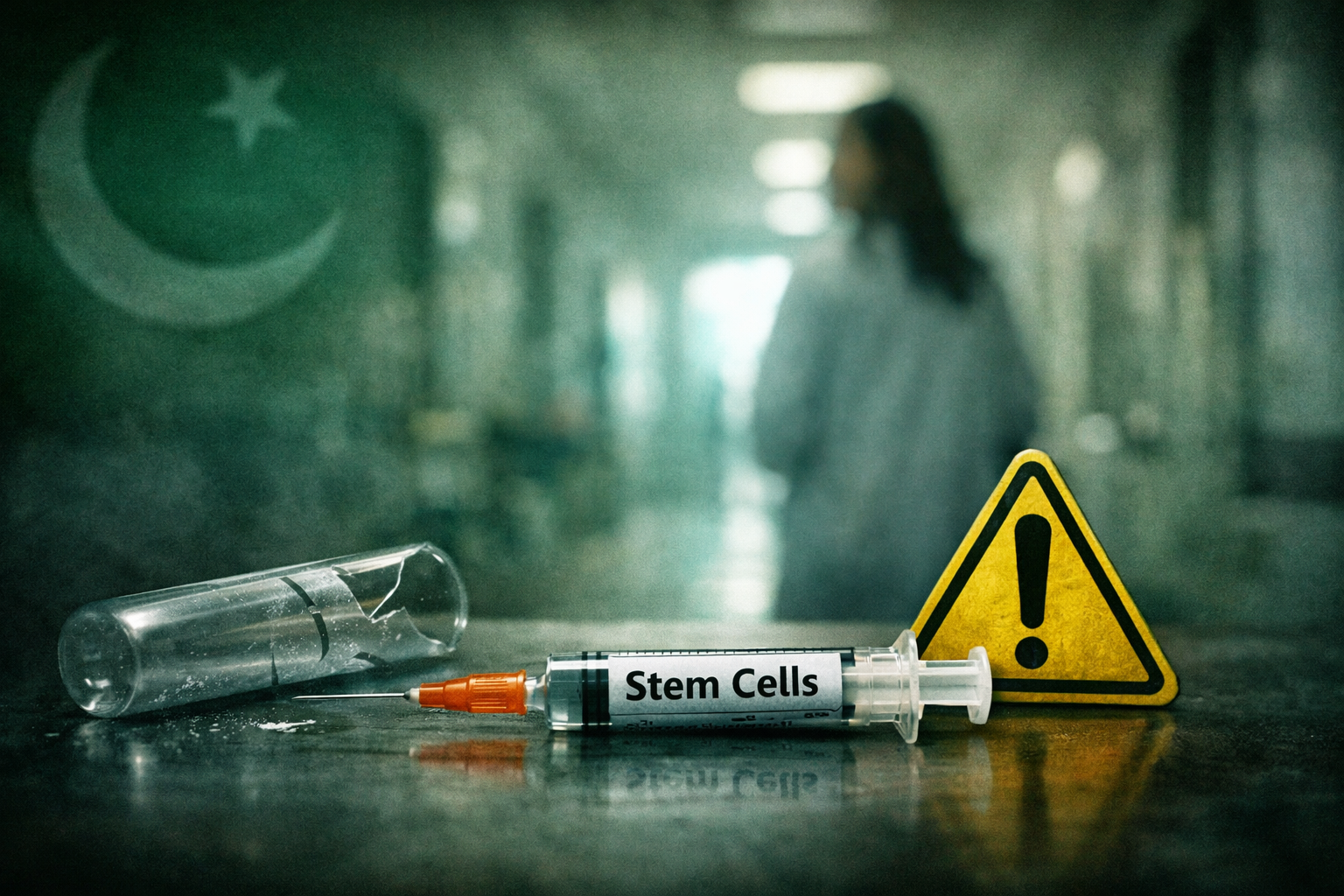
Serious allegations surrounding the use of unproven “stem cell” therapy for infertility in Punjab have triggered renewed scrutiny of Pakistan’s healthcare oversight, exposing what medical experts describe as a dangerous mix of medical misinformation, weak regulation, and commercial exploitation of vulnerable patients.
At the centre of the controversy is a written complaint submitted to Punjab Chief Minister Maryam Nawaz Sharif by Dr Ejaz Anjum, a fertility specialist based in Mirpur, Azad Kashmir, who has accused a private fertility practitioner operating hospitals in Lahore and Sargodha of running what he terms an organised deception under the banner of advanced medical science.
The Allegations
According to Dr Anjum, a lady doctor operating under the name of Sakina Hospital allegedly offers stem cell injections to couples suffering from irreversible infertility, including cases where ovaries or testes are medically incapable of producing eggs or sperm. He claims patients are assured that stem cell therapy can restore fertility—despite no recognised medical authority anywhere in the world approving such treatment for humans.
Dr Anjum alleges that patients are charged between seven and eight lakh rupees per case, often framed in foreign currency equivalents, for procedures he says are scientifically baseless and ethically indefensible.
The expert maintains that stem cell research related to fertility remains confined globally to early-stage laboratory and animal studies, primarily involving mice, with no conclusive evidence of success in humans. Commercial application of such therapy, he states, is prohibited across the United States, Europe, China, India, and Bangladesh.
Global Science vs Local Practice
Senior fertility consultants contacted by The Scoop corroborated that there is no approved stem cell-based fertility treatment anywhere in the world. International regulators permit stem cell use only within tightly controlled clinical trials, not as routine or commercial medical services.
Experts warn that presenting experimental or non-existent treatments as guaranteed solutions constitutes medical fraud. Even more concerning, they say, is the administration of unregulated biological injections, which may carry serious health risks including immune reactions, abnormal cell growth, and long-term complications.
Patients Speak Out
Several patients who spoke to The Scoop on condition of anonymity described being promised “miracle” outcomes after years of failed fertility treatments. Many said they were told stem cell therapy was their “last hope” and that conventional doctors were “outdated” or uninformed.
One woman from central Punjab said she was diagnosed with ovarian failure yet assured that stem cells would “revive” her reproductive system. After repeated injections and months of treatment, no pregnancy occurred.
Another patient said he was medically incapable of producing viable sperm but was promised reversal through stem cell therapy.
He reported financial ruin and psychological trauma after repeated procedures yielded no results.
Some patients also alleged physical complications following injections, though none were provided written documentation explaining what substances were administered or whether the procedures were experimental.
A Business Built on Vulnerability
Healthcare analysts say fertility treatment in Pakistan has increasingly become a high-revenue industry operating in a regulatory grey zone. Clinics often rely on scientific jargon, emotional persuasion, and selective success narratives to market treatments to desperate couples.
Payments are frequently structured in multiple cycles, with patients encouraged to continue despite lack of progress. Medical ethicists argue that this shifts responsibility away from providers and places the burden of failure on patients.
“Informed consent is not optional,” a senior fertility consultant said. “If a treatment is experimental or unproven, the patient must be told clearly. Anything less is deception.”
Regulatory Breakdown
Despite the seriousness of the allegations, experts say Pakistan lacks a clear enforcement mechanism to prevent such practices. Regulatory bodies are often reactive, acting only after prolonged complaints or media exposure.
Internationally, clinics offering unapproved stem cell therapies have faced criminal prosecution, licence revocation, and heavy fines.
In Pakistan, however, inconsistent enforcement has allowed questionable practices to continue for years without visible consequences. Public health advocates warn that such failures not only harm patients but also damage Pakistan’s medical reputation globally.
Calls for Government Intervention
Dr Anjum, who says he spent over 22 years in the United States working in IVF and stem cell research, claims he has repeatedly raised these concerns with authorities, the judiciary, and the media over the past two years.
In his complaint, he urged the Punjab government to constitute an independent panel of senior fertility specialists to examine the legitimacy of stem cell claims being made in private clinics. He argued that decisive action would deter future malpractice and restore public confidence in the healthcare system.
The complaint has been copied to the Chief Justice of Pakistan, the Punjab Healthcare Commission, the Pakistan Medical Commission, and several major television networks.
Awaiting Accountability
The allegations outlined in this report have not yet been adjudicated by a court of law. The Scoop has contacted the hospital and practitioner named in the complaint, as well as relevant regulatory authorities, for comment. Their responses will be published if received.
For the patients who spoke to The Scoop, however, accountability is long overdue.
“We accepted that we could not have children,” one woman said. “What we cannot accept is that someone used our pain to make money.”
As pressure mounts on the Punjab government, the case is increasingly seen as a test of whether Pakistan’s institutions are willing—and able—to protect patients from medical exploitation in one of the most emotionally sensitive areas of healthcare.
The Scoop will continue to monitor developments closely.




 Web Desk
 Web Desk


