
 Web Desk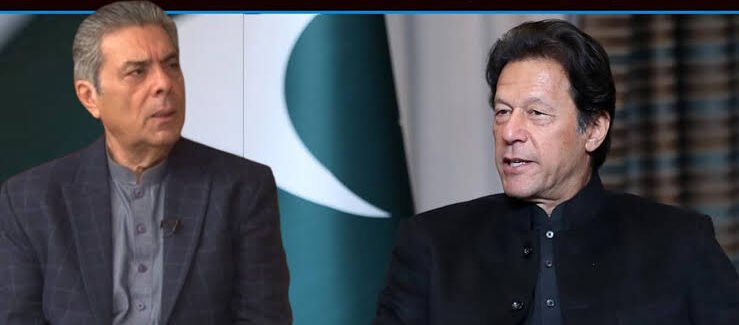
Renowned political analyst Hafeezullah Khan Niazi has said that Pakistan’s biggest challenge at present is Imran Khan, asserting that the country’s political system and state institutions have effectively become “hostage” to the former prime minister’s politics.
In his column for Daily Jang, Niazi argued that the ongoing confrontation between Imran Khan and the military establishment is the result of mistakes made by both sides. He maintained that Imran Khan’s political inexperience benefitted the establishment, while flawed institutional policies, in turn, strengthened Khan’s political narrative.
According to Niazi, political instability has become Pakistan’s most serious and persistent problem, affecting every sphere of national life. He said the country’s economic difficulties, social deterioration and governance crises all stem from chronic political uncertainty, which has now assumed the form of a long-term and dangerous ailment.
Drawing international comparisons, Niazi pointed out that resource-rich countries such as Venezuela and Nigeria have also suffered severe instability due to political chaos. In contrast, he noted, economically successful nations share one common trait: political stability.
Referring to Pakistan’s economic performance during the 1960s, Niazi recalled that the country had once achieved remarkable growth, with annual growth rates ranging between 9 and 11 per cent. He said the period was marked by development and prosperity, but the political instability that emerged under Ayub Khan’s rule ultimately led to his removal. The situation, he added, deteriorated further and culminated in the tragic separation of East Pakistan.
Niazi observed that Pakistan’s history has been marked by repeated shifts in power structures, none of which have produced sustainable outcomes. From the Rawalpindi Conspiracy Case of 1951 to the present day, the country has remained trapped in a recurring cycle where new experiments are introduced but yield the same results. He stressed that the real question is not how long the current system will survive, but whether Pakistan can learn from past mistakes and achieve lasting political stability.
Highlighting the country’s troubled civil-military relations, Niazi said it was unfortunate that no prime minister since 1953 had been able to govern with complete autonomy. Leaders including Muhammad Ali Bogra, Zulfikar Ali Bhutto, Nawaz Sharif and Imran Khan all came to power with institutional backing, but were sidelined once they attempted to assert independence.
Referring specifically to Nawaz Sharif, Niazi said his relations with the military establishment remained strained throughout his tenures. He noted that Sharif faced repeated efforts to weaken his government, including sustained political pressure and mass protests, particularly during 2013, which ultimately destabilised his rule.
Niazi further stated that the mistrust between civilian leadership and the military, which first emerged in the early 1950s, continues to persist. He emphasised that state decisions are institutional rather than personal, and therefore responsibility cannot be placed on a single military chief. According to him, both the rise and fall of Imran Khan were institutional decisions rather than the result of individual actions.
He added that while Imran Khan’s popularity created political turbulence, it failed to exert meaningful pressure on the establishment. However, the prolonged political confrontation has significantly weakened the state and pushed the country deeper into instability.
Niazi concluded by reiterating that the ongoing standoff between Imran Khan and the establishment is a product of mutual miscalculations. He said Khan’s lack of political maturity strengthened institutional control, while flawed establishment policies enhanced Khan’s political appeal. He warned that the coming months would be critical for Pakistan’s political future, as decisions taken during this period would shape the country’s direction for years to come.

 Hassan Naqvi

 Web Desk


