
 Hassan Naqvi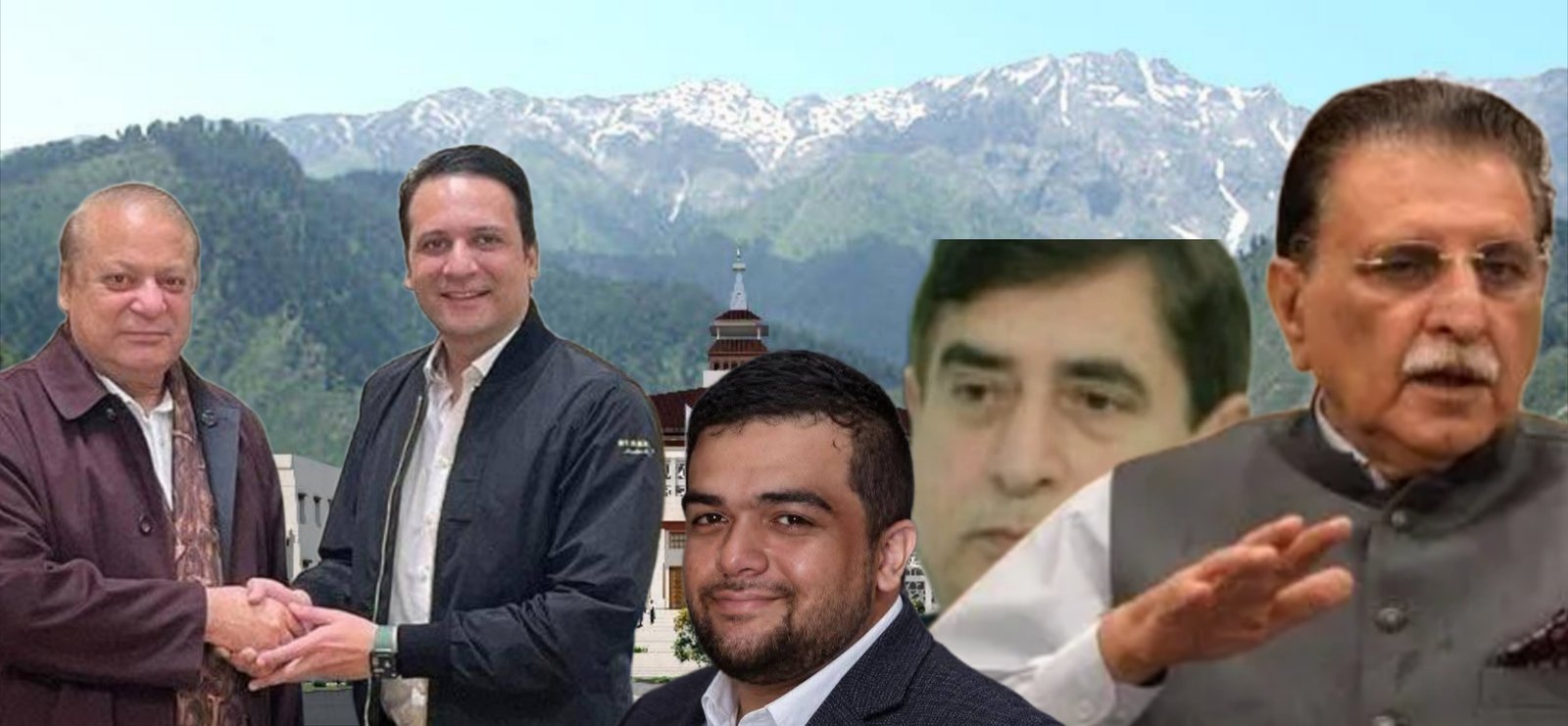
The appointment of Syed Iftikhar Ali Gillani has ended the immediate question of who will govern Azad Jammu and Kashmir — but it has opened a much bigger question: can the new prime minister turn a centrally engineered political transition into a genuinely stable government?
The election of Barrister Syed Iftikhar Ali Gillani as the 17th prime minister of Azad Jammu and Kashmir marks the formal return of the Pakistan Muslim League-Nawaz to power in the region after a decade.
Gillani secured 30 votes in the Legislative Assembly against 14 received by Pakistan Peoples Party candidate Sardar Mukhtar Ahmed Abbasi. The numbers demonstrate that the PML-N entered the contest with a clear parliamentary advantage. Its strength stood at 32, including an ally, against 14 PPP members, while seven seats remain vacant because elections in Poonch and Sudhnoti could not yet be held.
On paper, therefore, Gillani’s election looks straightforward.
Politically, however, it was anything but straightforward.
The real story behind his elevation lies in the backlash that emerged inside the PML-N’s AJK chapter before the vote — and in what that backlash says about the relationship between the party’s central leadership and its elected leadership in Kashmir.
The first problem: Gillani’s nomination was not universally welcomed
The most important political development surrounding Gillani’s appointment was the resistance from elements of the PML-N’s own AJK leadership.
Reports indicated that Shah Ghulam Qadir and former AJK prime minister Raja Farooq Haider had reservations about the proposed arrangement. A meeting involving senior party figures failed to immediately produce consensus, while the nomination generated criticism within party circles.
The controversy was particularly sensitive because Gillani had entered the Assembly through a reserved technocrat seat after failing to win a general-election constituency. Critics inside the party questioned the political wisdom of elevating someone who had not secured a direct electoral mandate to the region’s highest political office, especially when several PML-N politicians had won their constituencies directly.
That criticism touched an especially sensitive nerve.
PML-N’s political identity has long been associated with the slogan of respecting the vote. Consequently, the decision to elevate a politician who entered the Assembly through a technocrat seat inevitably created an optics problem.
The issue was not necessarily whether Gillani was constitutionally qualified. He was.
The issue was political legitimacy.
And in AJK, where questions of representation, regional autonomy and the relationship between Muzaffarabad and Islamabad have historically carried enormous political weight, optics matter.
The “respect the vote” dilemma
The backlash can therefore be understood through a simple contradiction.
On one side was the argument that the party had won a mandate and was entitled to choose its leader.
On the other was the argument that those who actually won constituencies should have a stronger claim to the premiership.
This is more than an internal PML-N dispute.
It creates a credibility test for Gillani himself.
If his government delivers, the controversy over the route through which he reached the premiership will gradually lose political importance.
If his government struggles, opponents will repeatedly return to the same argument: that the prime minister was selected by the party hierarchy rather than emerging naturally from the electoral battlefield.
That makes performance particularly important for Gillani.
Islamabad’s role
The nomination also highlighted another longstanding feature of AJK politics: the influence of Pakistan’s federal political leadership over the region’s political direction.
Gillani’s candidacy was ultimately endorsed by the PML-N’s central leadership. Reports said Prime Minister Shehbaz Sharif had finalized Gillani as the party candidate, while PML-N’s central leadership was involved in attempts to manage the disagreement among senior AJK leaders.
Gillani himself acknowledged the role of the national leadership after taking oath, expressing gratitude to PML-N supremo Nawaz Sharif, Prime Minister Shehbaz Sharif, Punjab Chief Minister Maryam Nawaz and other senior party leaders.
Politically, that gives Gillani considerable backing.
But it also creates an obvious challenge.
He must now demonstrate that he is not merely the choice of Islamabad.
The new prime minister’s biggest political task may therefore be to convert central-party backing into local political ownership.
The most important development: Farooq Haider returns to the room
The episode involving former prime minister Raja Farooq Haider is particularly revealing.
Despite the earlier disagreement, Haider eventually attended the Assembly session. According to reporting, Gillani personally drove to Haider’s residence and persuaded him to attend.
That may appear to be a small political gesture.
It is not.
In parliamentary politics, the management of dissent inside one’s own party is often more important than defeating the opposition.
Gillani understood that winning the vote was only the beginning.
He needed to prevent the nomination dispute from becoming a permanent factional conflict.
His outreach to Haider suggests that the new premier recognizes the difference between possessing a numerical majority and possessing political cohesion.
The former can elect a government.
The latter allows a government to survive.
Shah Ghulam Qadir’s absence remains politically significant
The absence of PML-N regional president Shah Ghulam Qadir from the voting process was another visible sign that the nomination controversy had not disappeared simply because the Assembly ultimately elected Gillani.
Gillani won, but the episode demonstrated that there are influential figures inside the ruling party who do not necessarily see the new arrangement as their preferred political settlement.
This could become important later.
A government with a 30-vote mandate in a chamber where the PML-N and its allies possess a comfortable majority does not face an immediate numerical threat.
But political instability rarely begins with numbers.
It begins with relationships.
If disgruntled party figures remain outside the decision-making structure, internal disagreements can eventually translate into pressure over cabinet appointments, development allocations, institutional postings and the distribution of political influence.
Gillani’s first real political challenge, therefore, may not come from the opposition benches.
It may come from within his own house.
PPP has lost government — but not relevance
The Pakistan Peoples Party has now moved into opposition after controlling the previous government.
Its candidate, Sardar Mukhtar Ahmed Abbasi, secured 14 votes, effectively matching the party’s Assembly strength.
PPP leader Chaudhry Muhammad Yasin has subsequently been appointed Leader of the Opposition.
The PPP’s immediate challenge will be to transform its defeat into an effective opposition strategy.
The party has already alleged irregularities and rigging in the wider election process. PML-N, meanwhile, emerged with 25 seats from the direct elections compared with PPP’s 12 before the reserved-seat arithmetic strengthened the ruling party’s position.
The opposition therefore has limited ability to threaten the government through parliamentary numbers.
Its stronger weapon will be political pressure outside the Assembly.
That could include questions over governance, development, employment, corruption, electoral transparency and the government’s relationship with Islamabad.
The wider AJK environment is far more difficult than the Assembly numbers suggest
Gillani is assuming office at an unusually sensitive moment.
The 2026 AJK elections themselves were conducted in phases because of security and law-and-order concerns. Polling in seven constituencies of Poonch and Sudhnoti was postponed, leaving the Assembly incomplete.
At the same time, the election process took place against a backdrop of public unrest and protests associated with the Joint Awami Action Committee.
The wider political environment therefore cannot be reduced to PML-N versus PPP.
There is a third dimension: public dissatisfaction with governance and the political establishment.
That is potentially far more dangerous for any incoming government.
A government can manage an opposition party.
It is much harder to manage a population that believes political parties are not addressing its economic and administrative concerns.
Gillani’s first speech was therefore politically important
The new prime minister appears to understand this.
In his maiden address, Gillani focused on employment generation, merit-based recruitment, transparency, the digital economy and curbing corruption. He also spoke about education, healthcare and development and expressed concern over the delay in elections to the remaining seven constituencies.
These are not accidental talking points.
They directly address some of the issues that can generate political frustration among young people.
Employment, merit and transparency are especially significant.
AJK has a relatively young population, while public-sector employment and government patronage have traditionally carried substantial political importance.
Gillani’s promise to emphasize private-sector job creation is therefore potentially more significant than a conventional promise of development schemes.
His stated objective of preventing young people from being diverted towards “negative activities” also indicates an awareness that unemployment and political alienation can become security problems.
The unfinished electoral mandate
Another complication is that Gillani has inherited an Assembly that is not yet fully representative of all constituencies.
Seven seats remain vacant because elections in Poonch and Sudhnoti were postponed amid security concerns. Gillani himself expressed hope that elections would be held soon so that the Assembly could attain its full strength.
Those elections will matter.
Not simply because they will add seven legislators, but because they could alter the political narrative.
If the PML-N performs strongly in those constituencies, Gillani’s government will gain additional legitimacy.
If the PPP or another political force performs well, the opposition could claim that the government’s current parliamentary strength does not fully reflect the political mood across the region.
For that reason, the remaining elections should be viewed as the first significant political test of the new government.
The bigger question: can Gillani unite the PML-N?
Gillani’s greatest immediate challenge is not defeating PPP.
The numbers have already settled that question.
His challenge is to reconcile the different factions and personalities within the PML-N.
The party has senior politicians with their own political constituencies, former prime ministers, regional leaders and figures who expected to play a role in government formation.
A successful prime minister cannot afford to treat these figures simply as supporters who must obey the central command.
He needs them as stakeholders.
The initial controversy over his nomination has therefore provided Gillani with an early lesson: political authority in AJK cannot be sustained entirely through endorsement from Lahore or Islamabad.
It must also be constructed in Muzaffarabad.
A test for Nawaz Sharif and Shehbaz Sharif too
The Gillani episode is also a test for the PML-N’s national leadership.
The party has returned to power in AJK after roughly a decade, giving Nawaz Sharif and Shehbaz Sharif an opportunity to establish a durable political base in the region.
But the central leadership must now avoid the temptation of treating AJK simply as another province-level political unit.
The region has its own political sensitivities and historical dynamics.
A government that is perceived as excessively controlled from Islamabad could face resistance even if it remains numerically secure inside the Assembly.
The best outcome for PML-N would therefore be a government that enjoys Islamabad’s support while simultaneously demonstrating meaningful political independence and responsiveness in AJK.
That balance will determine whether Gillani’s appointment becomes a political success or merely another chapter in the region’s revolving-door politics.
The backlash may ultimately help Gillani — if he handles it correctly
There is an ironic possibility in all of this.
The controversy surrounding Gillani’s appointment could actually strengthen his premiership if he responds intelligently.
By reaching out to senior party figures, including Raja Farooq Haider, he has already shown one potentially important instinct: reconciliation rather than confrontation.
If he continues on that path, incorporates different PML-N factions into the governing structure and gives elected politicians meaningful roles, the initial backlash could gradually disappear.
But if the government becomes dominated by a small circle around the prime minister and central leadership, the original criticism will acquire new life.
Then the question will no longer be why Gillani was chosen.
It will be why the party chose him despite the concerns of its own senior leadership.
What Gillani must deliver
The new government’s political survival can ultimately be reduced to five tests:
First, jobs.
The promise of employment generation must translate into an economic strategy rather than merely government recruitment.
Second, merit.
If Gillani has made merit-based appointments a central promise, his government will be judged against every controversial recruitment and posting.
Third, transparency.
The promise to curb corruption creates expectations that cannot be met through slogans alone.
Fourth, internal unity.
PML-N’s parliamentary majority is strong, but maintaining unity among its senior AJK leaders will be essential.
Fifth, public trust.
The government’s biggest opponent may ultimately be public frustration rather than PPP.
A fragile beginning, but a potentially consequential premiership
The election of Iftikhar Gillani has resolved the immediate political uncertainty in AJK.
It has not resolved the deeper political questions.
The new prime minister inherits a comfortable parliamentary majority, the backing of the federal PML-N leadership and an opportunity to establish a new political chapter for the party in Azad Jammu and Kashmir.
But he also inherits internal party reservations, an opposition that can exploit every governance failure, seven unfinished constituencies, a region with a history of public agitation and a population increasingly demanding transparency, employment and effective governance.
His 30 votes are enough to make him prime minister.
They are not enough to guarantee political stability.
That will depend on what he does with the authority those votes have given him.
For Gillani, the real election begins now.
The first contest was for the premiership.
The second — and much harder — contest is for legitimacy.
And that contest will be fought not inside the Assembly chamber, but among the people of Azad Jammu and Kashmir.

 TS Exclusive

 Web Desk
 Web Desk


