
 Hassan Naqvi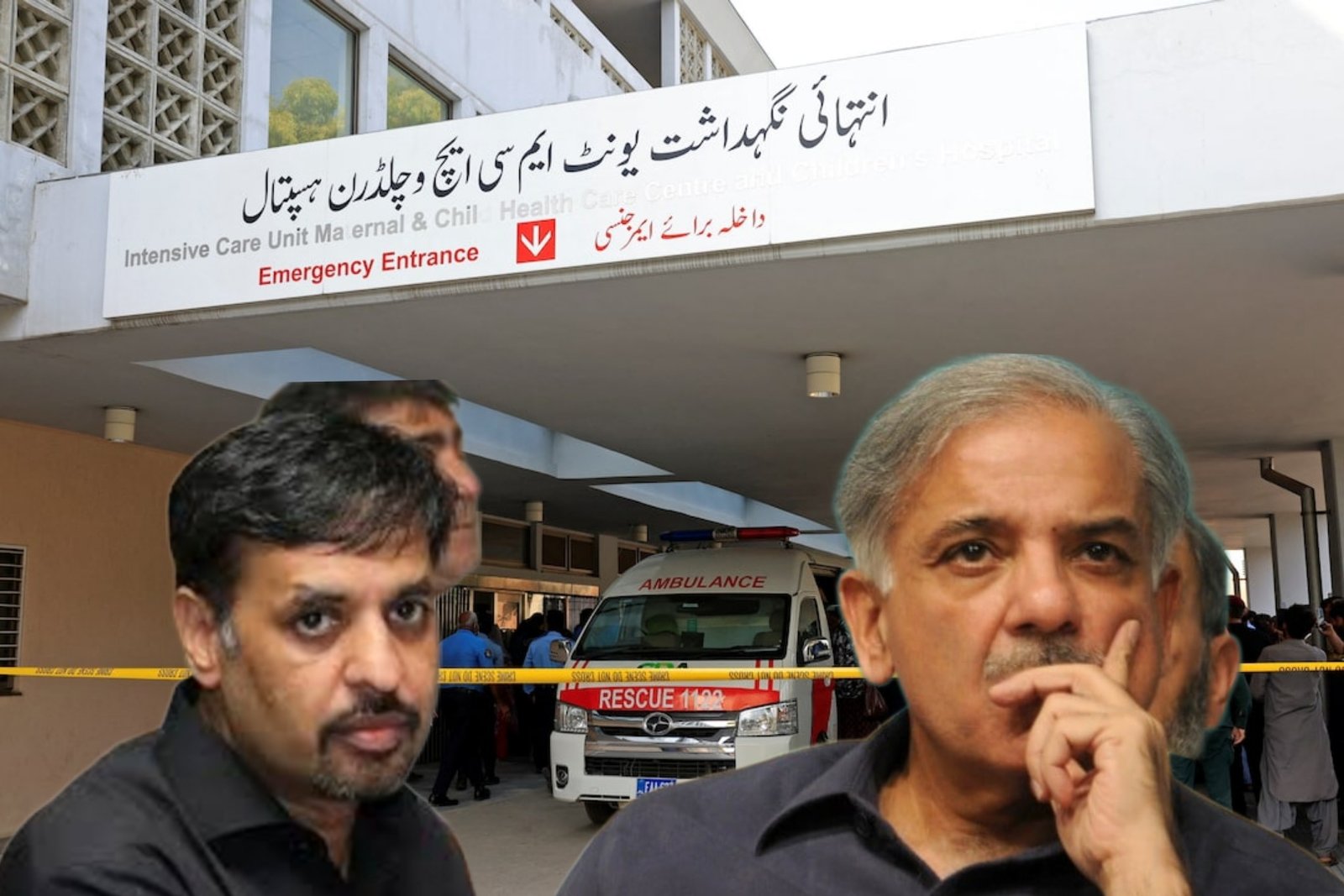
Fourteen newborns are dead. But the bigger question is whether Wednesday’s tragedy was the result of one malfunctioning appliance — or years of warnings that were never acted upon.
ISLAMABAD — Fourteen newborn babies are dead, one infant survived, and a government hospital is now at the centre of an investigation that could determine whether Pakistan Institute of Medical Sciences (PIMS) was merely the scene of a horrific accident — or whether institutional failures turned an emergency into a mass-casualty tragedy.
The fire that erupted in the Mother and Child Health Centre nursery on Wednesday morning, August 26, has exposed a troubling question: how many warnings does a public hospital have to receive before a preventable risk becomes a catastrophe?
PIMS is not an ordinary hospital. Conceived as the capital’s premier tertiary-care institution, it now serves patients from Islamabad, Punjab, Khyber Pakhtunkhwa, Gilgit-Baltistan, Kashmir and other areas. Its official website lists Islamabad Hospital, Children’s Hospital, Mother & Child Health Centre, Cardiac Centre and Burn Care Centre among its major components. Its published statistics show an enormous daily patient burden, including more than 1,200 OPD patients and over 200 emergency cases a day at Islamabad Hospital alone.
That makes Wednesday’s tragedy more than a fire.
It is a test of the entire system.
The 60-second question
Federal Health Minister Mustafa Kamal said CCTV footage showed a spark falling from an air-conditioning unit and the fire engulfing the room within roughly a minute.
“It’s all visible in the CCTV footage,” Kamal told reporters. “A spark came down from the AC onto the floor. Within 1 minute … the whole room was on fire.”
The minister also said the babies were connected to oxygen and that oxygen appeared to have accelerated the fire.
The distinction is crucial.
Oxygen does not itself burn, but an oxygen-enriched environment can dramatically intensify combustion. In a nursery where critically ill newborns are connected to oxygen equipment, fire-prevention systems, alarms, evacuation routes and trained emergency personnel are therefore not optional safeguards.
They are the last line between a technical fault and mass death.
And that line appears to have failed.
No sprinkler system
One of the most disturbing revelations is that the nursery did not have an automatic sprinkler system.
Kamal acknowledged that fact while describing the emergency response. Staff reportedly used fire extinguishers to combat the flames. PIMS subsequently said that 35 extinguishers were available and used during the response.
The absence of sprinklers raises an obvious investigative question:
Was the nursery ever assessed against modern fire-safety requirements, and if deficiencies were identified, why were they not corrected?
The answer matters because the fire was not occurring in an ordinary office.
It was occurring in a neonatal environment where infants could not walk, crawl, or escape independently.
The locked-door controversy
Perhaps the most serious allegation concerns evacuation.
Families told journalists that access doors were closed or locked. One father, Mudasir, told Reuters that the building had “no fire security, no proper exits” and that only one door was available to families visiting their children.
A grieving mother, Jaweria, also questioned why the children had been left inside.
“I do not believe this. Give me my child back … why did the doctors leave the children there?” she said, according to reporting carried by ABC.
But PIMS Executive Director Rana Imran Sikander disputed the claim that the door was locked.
He told the BBC that the door was not locked but was manned. The hospital’s explanation was that controlled access was necessary to prevent infant abduction, a problem authorities say has occurred in public hospitals.
That creates a question the inquiry must answer objectively:
If the door was not locked, was it capable of being opened immediately from inside and outside during a fire? If it was controlled, who had the key or access mechanism? And was that mechanism compatible with emergency evacuation requirements?
These are not questions that can be settled through competing statements.
They require physical inspection, CCTV footage, access-control records, fire-safety certificates, staff statements and forensic examination.
CDA findings deepen the mystery
The Capital Development Authority’s fire and disaster-management assessment reportedly found the fire and life-safety arrangements in the affected nursery inadequate and below required standards.
Reports based on the CDA assessment also said emergency exits were locked from outside or obstructed, while security arrangements allegedly complicated the initial firefighting response.
The CDA account also differs in important respects from some early hospital and media accounts concerning the number of children rescued and the number of deaths.
That discrepancy itself warrants examination.
The official investigation should establish, minute by minute:
- when the first spark occurred;
- when the alarm was activated;
- whether the fire alarm actually functioned;
- when hospital staff became aware of the fire;
- when the fire brigade was called;
- when the first responder reached the ward;
- which exits were usable;
- who controlled access to the ward;
- how many trained staff were physically present;
- how many infants were inside;
- how many were connected to oxygen;
- and exactly how each infant was accounted for.
Until that timeline is reconstructed, the public is being asked to accept explanations before the evidence has been fully examined.
This is not PIMS’ first warning
The most troubling element of the PIMS story is that institutional concerns did not begin on Wednesday.
A Federal Ombudsman committee report on PIMS documented serious nursing shortages. It found that nurses in general wards were working at approximately a 1:25 nurse-to-bed ratio, compared with a cited standard of 1:10.
In critical areas, the report cited a ratio of approximately one nurse for three beds, while noting that 154 charge-nurse posts were vacant.
Those figures are not allegations from a grieving family.
They are contained in an official institutional assessment.
The same report recommended filling vacant posts and increasing nursing strength to improve patient care.
The relevance to the nursery tragedy is obvious, although it would be premature to claim that staffing shortages caused Wednesday’s deaths.
The investigation must instead determine whether staffing levels, training and emergency preparedness affected the speed and effectiveness of the rescue.
Warnings from the Ombudsman kept returning
PIMS has been examined by the Federal Ombudsman before.
In 2015, a committee constituted by the Wafaqi Mohtasib proposed wide-ranging structural changes after complaints about the hospital. The recommendations included changes to the governance structure and management system.
A subsequent report described the absence of approved rules and regulations for governance as a fundamental source of maladministration at the hospital.
And this is not merely history.
In May 2026, the Federal Ombudsman again took notice of complaints against PIMS and constituted an inspection team to examine complaints, meet the administration and speak directly with patients. The team was also tasked with assessing whether recommendations from previous inspections had been implemented.
That creates perhaps the most important investigative question of all:
What happened to the recommendations made by successive oversight bodies?
If safety, staffing, governance and patient-care weaknesses had previously been identified, who was responsible for implementing corrective measures?
And if recommendations were implemented, why did the institution still apparently lack adequate fire protection in a nursery housing critically ill newborns?
Procurement questions cannot be ignored
An investigation into PIMS must also examine the institution’s procurement history.
An Auditor General report recorded that PIMS incurred Rs134.078 million in expenditure on medicines for Pakistan Bait-ul-Mal beneficiaries through purchases from suppliers other than approved suppliers. The wider audit identified Rs614.512 million in medicine expenditure across several hospitals where open-tender requirements were not followed.
This does not establish that money intended for fire safety was misappropriated, nor does it establish a link between medicine procurement and Wednesday’s deaths.
But it does establish something important for an investigative inquiry:
PIMS has previously faced documented questions over procurement controls.
Therefore, investigators should follow the money relating specifically to fire prevention.
That means examining:
- fire-safety equipment purchases;
- maintenance contracts;
- air-conditioning maintenance;
- electrical inspections;
- fire alarms;
- extinguishers;
- emergency lighting;
- evacuation signage;
- sprinkler feasibility assessments;
- generator and electrical systems;
- fire drills;
- safety certifications;
- and payments made to contractors responsible for maintenance.
Every rupee spent on those systems should be matched against the equipment actually present at the nursery.
The air-conditioner cannot become the entire explanation
The easiest explanation is also the least satisfactory one:
The AC failed, a fire started, and babies died.
But an investigative report must ask a harder question:
Why was a single equipment failure capable of killing almost every newborn in a supposedly controlled medical environment?
Hospitals are designed around the assumption that equipment can fail.
Generators fail.
Electrical systems fail.
Air conditioners fail.
Oxygen systems can malfunction.
The purpose of hospital safety architecture is to prevent any one failure from becoming a catastrophe.
That is why fire alarms exist.
That is why emergency exits exist.
That is why sprinklers and extinguishers exist.
That is why staff are trained.
That is why drills are conducted.
And that is why high-risk neonatal units require particularly stringent safety arrangements.
If an AC fault could transform a nursery into a death trap within a minute, then the question is not simply why the AC failed.
The question is why the safety system failed to compensate for it.
A hospital already struggling under pressure
PIMS itself describes Islamabad Hospital as having nearly 1,800 employees and handling more than 1,200 OPD patients, approximately 60 inpatient admissions and more than 200 emergency cases daily.
Its 2022-23 institutional statistics recorded 1,140 beds, more than 77,000 admissions and an overall bed-occupancy rate of 70 percent. The Mother & Child Health Centre recorded an 87 percent occupancy rate, while the Burn Care Centre exceeded 100 percent occupancy.
These numbers illustrate the pressure under which the institution operates.
But heavy workload cannot become a permanent excuse for inadequate safety.
In fact, the opposite should be true.
The greater the patient load, the stronger the safety systems must be.
The state has continued to invest
The federal government allocated Rs900 million in the 2025-26 Public Sector Development Programme for stroke intervention and expansion of critical-care and cardiac facilities at PIMS.
That means the debate cannot simply be reduced to “there was no money”.
The more relevant questions are:
Where was the money going?
How much was spent on patient safety?
How much on infrastructure?
How much on maintenance?
How much on fire protection?
And who signed off on the safety condition of the buildings?
A hospital can receive billions in development funding and still remain unsafe if governance, maintenance and oversight are weak.
The 2023 warning that should be revisited
There is another uncomfortable piece of PIMS history.
In 2023, four patients died in the emergency ward over a two-day period amid reports linking the deaths to extreme heat caused by a malfunctioning air-conditioning system. The episode prompted criticism of hospital management and its infrastructure.
Three years later, another major incident involving an air-conditioning system has killed newborns.
The two incidents are not necessarily causally connected.
But they should be examined together because they raise the same institutional question:
How effectively does PIMS maintain critical infrastructure on which patients’ lives depend?
An independent technical audit should therefore examine the maintenance history of the affected nursery’s AC system, including:
- date of last preventive maintenance;
- contractor responsible;
- previous complaints;
- previous breakdowns;
- replacement history;
- electrical load;
- inspection certificates;
- work orders;
- payments;
- and whether any warning signs had been recorded before August 26.
Even basic equipment questions need answers
The health minister has acknowledged that there was no sprinkler system in the affected area.
The investigation should therefore determine whether:
- sprinklers were required under the applicable building/fire-safety standards;
- PIMS had ever sought approval for their installation;
- any safety inspection had recommended them;
- funds had been allocated;
- the building was structurally assessed for installation;
- alternative fire-suppression arrangements were considered;
- fire alarms were operational;
- emergency lighting was operational;
- fire drills had been conducted;
- staff had been trained specifically for neonatal evacuation.
These questions should be answered with documents, not press conferences.
The missing document trail
A serious inquiry should immediately secure the following records before they can be altered, lost or destroyed:
The nursery’s fire-safety certificate.
CDA inspection reports.
PIMS internal safety inspections.
Electrical inspection reports.
AC maintenance logs.
Fire-extinguisher inspection records.
Fire-alarm testing logs.
Emergency-drill records.
Staff duty rosters for August 26.
CCTV footage from the entire relevant period.
Security/access-control logs.
Procurement files for fire-safety equipment.
Maintenance contracts.
Payment records.
Previous complaints regarding the nursery.
This is the evidence that can establish accountability.
Accountability cannot end with one suspension
Prime Minister Shehbaz Sharif ordered an investigation and the federal health secretary was removed following the tragedy. A high-level probe has been tasked with determining what happened.
The Health Minister has also promised accountability.
“Everyone will have to go through accountability because human lives are involved,” Kamal said, adding that negligence, if established, would be addressed.
That is the correct principle.
But accountability should not mean simply suspending one official.
If negligence occurred, responsibility must be traced through the entire chain:
Who designed the system?
Who approved it?
Who inspected it?
Who maintained it?
Who certified it?
Who knew about deficiencies?
Who failed to correct them?
Who was responsible for emergency preparedness?
Only then can accountability become meaningful.
The tragedy must not disappear after the inquiry
Pakistan has witnessed too many tragedies followed by committees, press conferences and promises.
The PIMS investigation should be different.
Its report must be made public.
Its technical findings should be independently reviewed.
The recommendations should carry deadlines.
The responsible departments should be named.
Compliance should be publicly monitored.
And every major public hospital in Pakistan should undergo a similar fire-safety audit.
Because the issue is bigger than PIMS.
A newborn in a government hospital cannot protect himself.
He cannot run.
He cannot open a door.
He cannot pull a fire alarm.
He cannot escape smoke.
His survival depends entirely on the system around him.
At PIMS, fourteen newborns were placed in that system.
Only one survived.
That is why the investigation cannot stop at the question of what caught fire.
It must answer the far more uncomfortable question:
Why was the system unable to save them?
Until that question is answered — with documents, evidence and accountability — the PIMS fire should not be described simply as a tragic accident.
It should be investigated as a possible institutional failure that had been warned about long before the flames appeared.

 TS Exclusive

 Web Desk
 Web Desk


